Summative Entry: Australia is not a finished product

Australia is not a finished product. It’s a bold statement, but a true one. We may never be a finished product. This isn’t a bad thing, actually, it’s a very good thing. It is vital for us as a country to keep growing and developing and leave a better legacy for future generations than what previous generations have left us. 

Throughout the Australian Literature Unit, we have delved into the history of Australia and pieces of Art and Literature that assisted in shaping us into the nation that we are today.We have looked at Aboriginal influence, the incoming of the English, and the aftermath of this. I have attempted to cover this into my blog posts to the best of my ability.

My blog post in Week 4 covered my own personal family history. I touched on my relation to Frederick Meredith, a member of the First Fleet on the Scarborough ship. I then spoke about my own personal thoughts on Australian Citizenship. I stated “I believe that if you identify with Australia and its values, and feel at home here, then you are Australian. Race, gender, and religious beliefs should not matter. Being Australian, or a part of any country for that matter, all comes down who you identify with.” A piece of paper does not define your identity. Our government is forgetting this. People who have called Australia home for many years are being threatened deportation for things that are usually out of their control. We as a nation need some common sense. We as a nation have a lot of growing to do before we are anywhere near finished.
https://courtneyemattick.art.blog/2019/08/19/week-4-blog-who-is-an-australian/

My blog post in Week 8 was a letter to Patrick White in response to his essay ‘A Prodigal Son’. In this essay, he discussed his journey with Australia and reflected on his literature journey with our country. He made a statement in his essay about being ‘discontented’ after he started his new life, away from writing.This was what made him decide to write again, as it was what he could do with ‘any degree of success’. Australia can learn from Mr White’s statement, and his journey thereafter the statement. 
https://courtneyemattick.art.blog/2019/10/19/week-8-dear-mr-white/

Australia has forgotten it’s morals, what we are good at. We are a young country, we are a lucky country. This is what attracts people to our country, our morals. In the second verse of the national anthem, it states
For those who come across the sea
We’ve boundless plains to share
We are forgetting to share our land. The traditional owners share the land, albeit reluctantly, so that we, with the traditional owners, can share with those who come across the sea. Australia needs to learn to be more respectful and caring towards others.

Australia will never truly be finished, that’s a good thing. If we aren’t continually growing and learning as a nation, then we have failed as a nation. We need to leave this nation, having made it our dream, for those who will follow in our footsteps. We need to be the change we want to see in our country.
Week 10: Eve-Song

Which poem or story that we have looked at so far made an impression on you? What was the impression it made? Why did it touch your feelings and imagination?

In week 4, we looked a Mary Gilmore and her poem ‘Eve-Song’. I thoroughly enjoyed reading this poem and the discussion in the tutorials that followed. The poem spoke to my inner feminist, and i really enjoyed hearing the different views between the males and the females in the class.

I enjoyed reading Gilmore’s poem and seeing her perception of Man change. It started of with the narrator feeling neutral towards Man’s presence. They state:
But the heart of man was a wandering thing
That came and went with nothing to bring:

The narrator then turned to a more loving feeling towards Man in the second stanza with the line:
That more than man was love and prize

This was before the third stanza when she, in nice terms, rips Man to shreds. She mocks everything that he had once said, from his strength, to his truthfulness. I feel like this paragraph in particular really spoke to me because it really speaks to the current male stereotypes that are still present in culture to this day. While it’s obviously not all men, there are still men who will make false promises to love interests.

The final stanza contradicted the third stanza. This is because the narrator went from hating on Man, to welcoming him home with open arms and giving him a place to rest. It is almost as if she has these opinions about Man, but chooses to accept her fate and be a typical house-wife character, which was common in those days. 

This poem really shows how Australia as a nation has grown in terms of equality and the way we view women. This piece would have offended some people when it was written. I see it as a brave statement of society.

Week 8: Dear Mr White

I have recently your essay “The Prodigal Son” as apart of my University Literature class. I found it an interesting read. It allowed me to get a deeper insight into your experiences and life lessons, more so that a biography would do. I would like to discuss my thoughts on you essay with you.

I found it interesting how you started off referring to yourself in third person, before switching to first person and keeping it like that. At first, it confused me slightly as I thought you were referring to Mr Kershaw, rather than yourself. What was your thought process behind this unusual technique? When reading it, it seemed to me like you were having an out of body experience, before returning back to normal and continuing with your reflection. 

I can empathise with your statement of being ‘discontented’ with the new life you had made for yourself. I also will pick up a new task and be happy with it, before becoming discontented and going back to my roots. I’m certainly glad that you were able to find happiness within yourself to write again. 

Your final statement of “To me, the letters alone are reason enough for staying” was a perfect summary to the reflections made in the previous sentences. While you needed not a reason to stay, the letters received would have certainly been a heart warmer and assisted you in knowing that you had made the right decision.

Thankyou for imparting your literature and knowledge onto us. As a member of a future generation, I thank you. 

Sincerely
Courtney Mattick

Peer Review Week 10: Evelyn

Evelyn, I loved your piece! It was interesting reading about your thoughts on Lawson’s work compared to Paterson’s. I personally prefer Paterson’s work but enjoyed your insight into why you like Lawson’s work. I can now see why Lawson’s work could also appeal to a reader over Paterson’s. I personally found the structure of the blog to be a bit tricky to follow. I would have been great if you included quotes throughout the text, and also had quotes from Lawson’s work also, not just Paterson’s. Overall, a great read!

Link to Evelyn’s Blog: https://literaturetalk.home.blog/2019/08/25/realism-vs-idealism/

Peer Review Week 8: Tenielle

Tenielle, I really enjoyed reading your piece. The way you crafted your poem really helped me to imagine the scene that you were trying to create. I chose to read the poem first before taking a detailed look at the picture. You were able to capture each element of the painting in such a way that it strengthens the painting, rather than take away from it. For me, the first stanza didn’t flow as well as the rest. Otherwise, an excellent job.

Link to Tenielle’s Blog: https://thebestofliterature.art.blog/2019/09/02/the-balcony-2/

Peer Review Week 6: Abby

I really enjoyed reading your blog Abby! Your thoughts on Lisa Bellear’s ‘Urbanised Reeboks’ intrigued me and seeing your thought process through the photo of your notes was interesting. Though overall it was a tad long, I appreciated the work that went into the analysis of each stanza. The use of quotes from the poem as well as exceptional language choices on your behalf made me really think about what you had written and find a different kind of appreciation for Bellear’s work. You went above and beyond what the brief class discussion covered. I absolutely agree with your statement “It is uniquely written to leave the reader to understand and interpret the message based on their experiences“. Overall, a well articulated blog. Well done!

Abby’s Blog: https://australianliteratureblogs.home.blog/2019/08/10/welcome-to-my-blog/

Week 6: Art and Literature

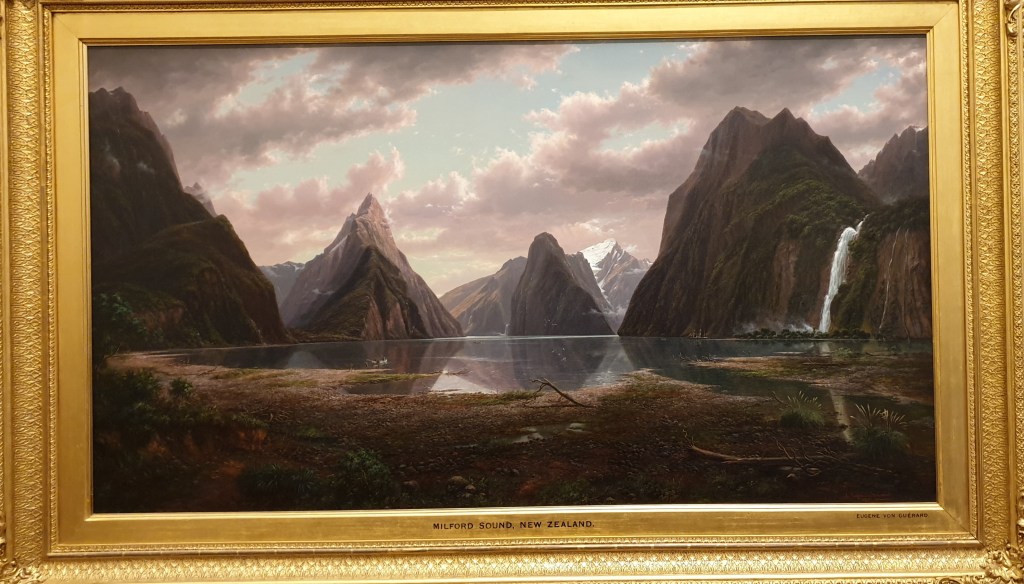
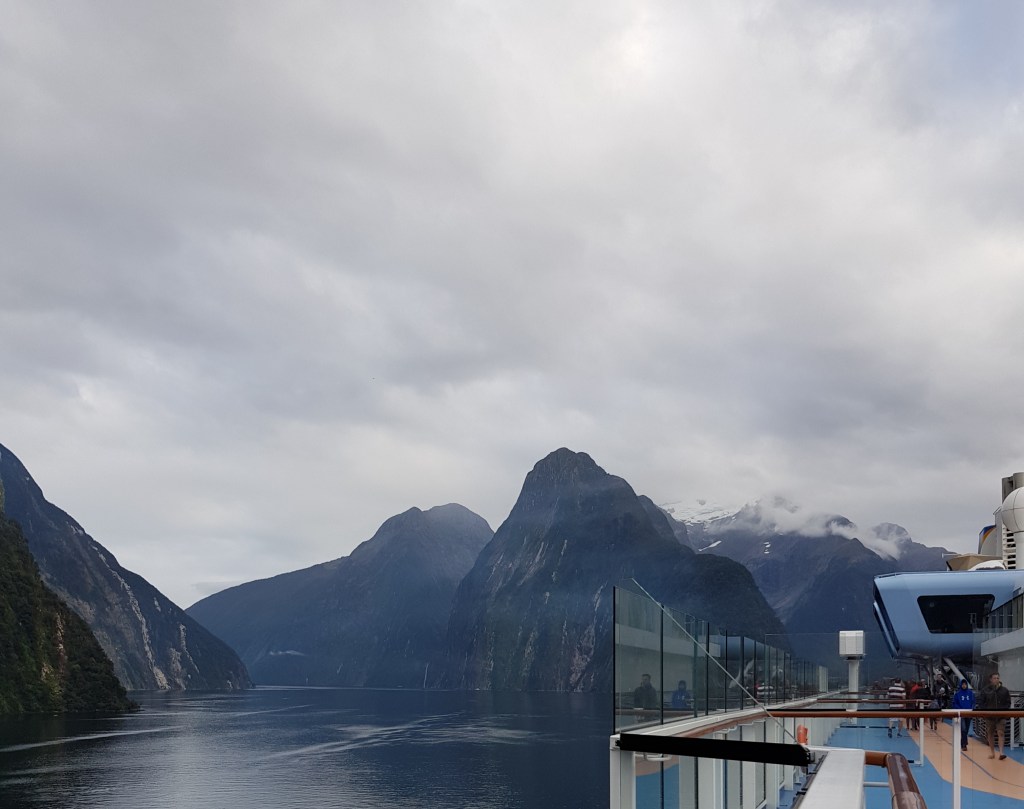
Art and Literature are creative formats that allow people to express themselves; they are able to capture a part of the artist’s spirit and enhance the readers emotions.  Last week, I visited the Art Gallery of NSW for my university literature class. It was an eye-opening visit. I had never really been a painting fan, I usually lean towards books and performances on stage to get my fix of Art and Literature. This all changed when I came across a painting by Eugene Von Guerard entitled ‘Milford Sound’. My eyes were drawn to it immediately. I visited Milford Sound in 2017, and the painting looked exactly how I remembered it, despite the fact that it was painted almost 150 years ago. The way Von Guerard painted the scene really made me feel that I was standing in New Zealand looking at Milford Sound. The small details in the painting, matched with the stunning colours in the clouds, made this piece my favourite of all that we saw at the Gallery. 

Art and Literature are so important in everyday life. As children, they assist in broadening our horizons and making our imagination bigger and brighter. As adults, they make us think about the world we live in and appreciate the artist and their hard work. Life without Art and Literature would be boring, like living in a black and white world. Art and Literature adds colour to our world, opens us up to a new form of appreciation not found anywhere else. While there is no one set definition of Art, I believe that if it touches your heart, then it is doing its job.

Peer Review Week 5: Anna

Anna, I enjoyed reading your piece. I really liked how you not only clarified the meanings of each poem, but gave examples through texts that we have studied in the unit. I enjoyed the end sentence “…we have to deconstruct the poem before we can be enlightened by its message” as I feel this really encaptures the meaning of Opaque poetry in a few short words. Your quick and sharp analysis of both poems, accompanied with a short quote, made for an enjoyable read. To improve, I would suggest splitting the 1 paragraph into 2 paragraphs, 1 for transparent and 1 for opaque, to make it a bit easier on the eyes. All in all, a great piece of writing.

Link to Anna’s blog: https://wp.me/pbaF1o-1w

Week 5: First-class Marksman

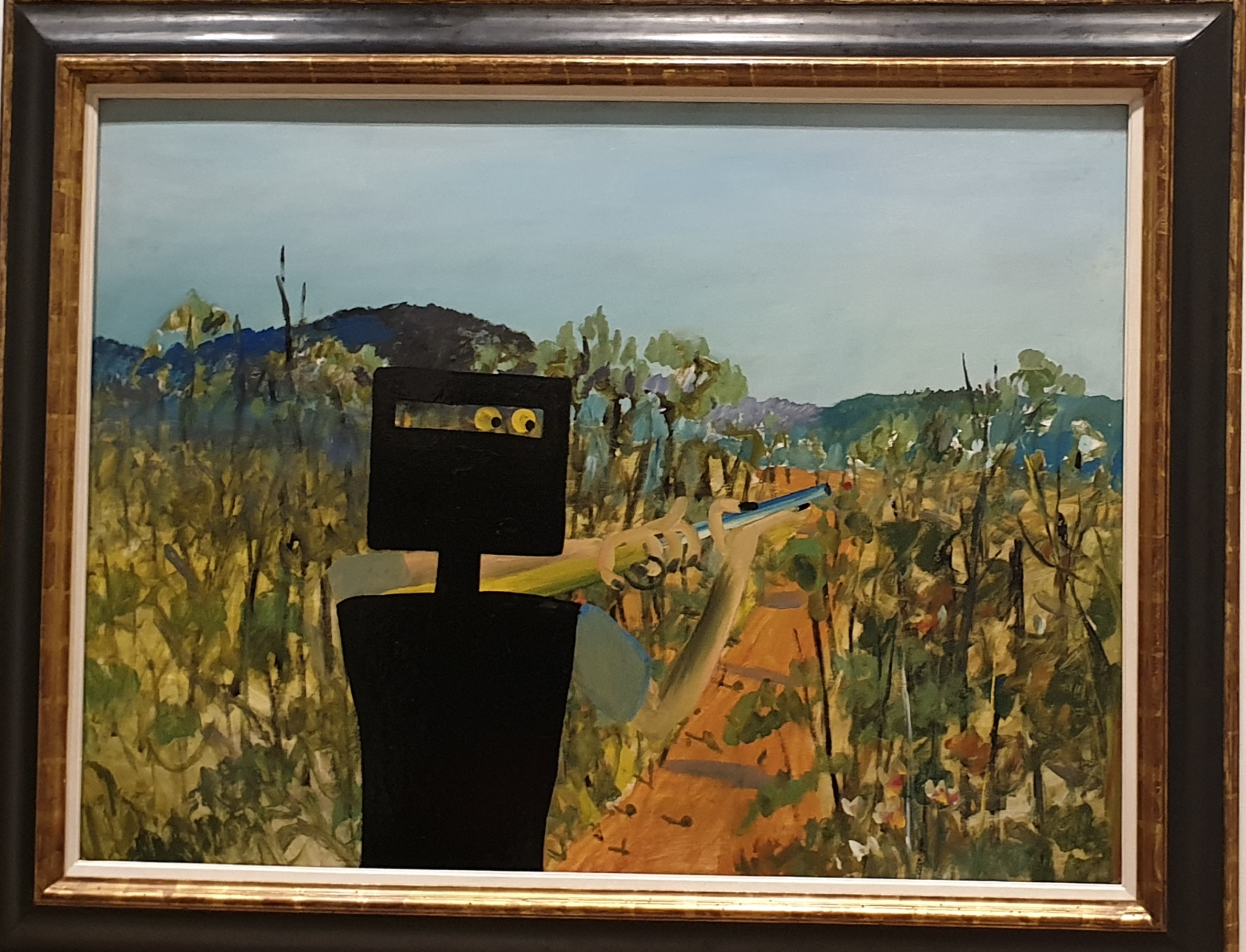
First-class Marksman by Sidney Nolan (1946). Picture taken by me

Edward ‘Ned’ Kelly was a famous bushranger in the late 19th Century. Sidney Nolan painted the above painting of him, entitled First-class marksman, in 1946. The picture shows Kelly in a field of either flowers or small trees, with a gun. The landscape has dark green mountains, indicating that it is covered with trees, and a dirt coloured ground. Kelly has a blue-green shirt on, but that is covered by his black armour. His eyes are yellow colour, looking out to the landscape. He is hunting.

I believe this painting depicts Ned as a hero. This is because he is very prominent in the picture, as well as being the only person. The gun isn’t obvious as it camouflages into the background. This makes me think that Nolan only painted the gun as a technicality, rather than to add to the painting. Even his clothing is a similar colour to the landscape. His armour is what attracts the eye when you look at the painting. The armour is placed on him like a cape. This could possibly be Nolan painting Kelly as a hidden hero, rather than the bushranger title that he is famous for. Sidney Nolan painted a lot of paintings of Ned, so this could also be perceived as an obsession on Nolan’s part.

http://adb.anu.edu.au/biography/kelly-edward-ned-3933

Week 4 Blog: Who is an Australian

Australia. This fine place that approximately 25 million people call home. Of those 25 million people, not one person’s story and heritage is the same as someone else. We all have our own stories about how we ended up here. Some people’s ancestors have lived here for hundreds of thousands of years, others migrated here recently, this makes Australia unique.

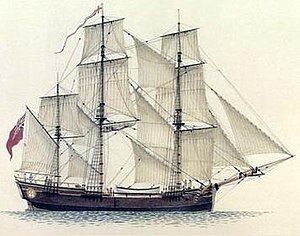
My personal story I would imagine is a fairly common one, but still unique. I had a relative on my Mother’s side who was a part of the First Fleet and made that first journey over from England to Australia. Frederick Meredith was aboard the ship Scarborough and was on the 5th highest pay rate of all the members onboard. He came over to Australia, married, fathered children, and then ultimately died here in 1833 (Swinfield). My Father’s side is, and will remain, a mystery, but from what I remember, I believe his family came over from England also. That makes me British, as is the case for many people. While I am technically British, I consider myself Australian. I was born here, I grew up here, I still live here now. I am an Australian. 

Some people define Australians as people with Australian Citizenship, if you have a citizenship you are Australian, if you don’t have a citizenship, then you aren’t Australian. This is an easy to understand concept of which I disagree with. I believe that if you identify with Australia and its values, and feel at home here, then you are Australian. Race, gender, and religious beliefs should not matter. Being Australian, or a part of any country for that matter, all comes down who you identify with. As the song says; I am, you are, we are Australian. 

Image result for scarborough ship first fleet
Scarborough Ship. Photo from Wikipedia

Reference List
Swinfield, David. “Fellowship Of First Fleeters”. Fellowshipfirstfleeters.Org.Au, 2019, http://www.fellowshipfirstfleeters.org.au/frederick_meredith.htm.

Design a site like this with WordPress.com
Get started